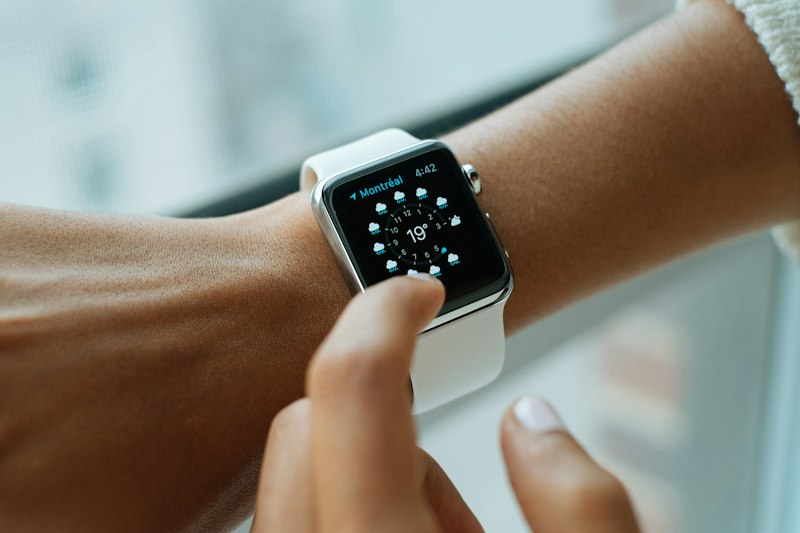
You just finished a hard workout and your Apple Watch says you burned 650 calories. You log it in your food app and "earn" an extra meal. But what if that number is off by 40%? That's not a hypothetical. Research shows calorie estimates from wearables are consistently inaccurate. Here's how bad it really is.
What the Research Says
A Stanford study tested 7 popular wearables (Apple Watch, Fitbit, Samsung Gear, and others) against lab-grade metabolic testing. The results:
- The most accurate device was off by 27% on average for calorie expenditure
- The least accurate was off by 93%
- Every single device overestimated calories burned
Why Wearables Get Calories Wrong
Heart Rate Is a Poor Proxy for Calories
Wearables estimate calories primarily from heart rate. The assumption: higher heart rate = more calories burned. But this breaks down in many scenarios:
- Caffeine raises heart rate without burning extra calories
- Stress and anxiety elevate heart rate at your desk
- Heat and humidity increase heart rate during exercise without proportional calorie increases
- Strength training burns fewer calories per heart beat than cardio, but wearables treat them the same
The Algorithm Problem
Wearables use population-average equations to convert heart rate into calories. These equations are based on average body composition, fitness level, and exercise type. If you're not average (and nobody is exactly average), the estimate drifts.
No Way to Measure Individual Metabolism
True calorie expenditure depends on your metabolic rate, body composition, exercise efficiency, and even gut microbiome. A wearable on your wrist can't measure any of these directly.
Which Wearable Is Most Accurate for Calories?
Relatively speaking:
- Apple Watch tends to be the most accurate for walking and running (within 20-30%)
- Garmin is decent for structured cardio with chest strap HR
- Whoop claims better accuracy through its strain algorithm but independent validation is limited
- Oura Ring doesn't even try to give workout calorie counts, which is honestly the most honest approach
- Strength training (overestimate by 40-80%)
- HIIT (overestimate significantly due to elevated HR during rest periods)
- Cycling (wrist movement doesn't correlate well with effort)
What to Actually Do With This Information
Stop Eating Back Calories
The biggest practical mistake: using your wearable's calorie burn to justify eating more. If your watch says you burned 500 calories and you eat a 500-calorie post-workout meal to "break even," you probably overate by 150-250 calories. Over time, this stalls weight loss or causes gain.
Use Relative Numbers, Not Absolute
Your watch might say you burned 400 calories, but the real value was 280. That's fine, because the important part is comparison. If the same type of workout shows 400 one day and 500 the next, the second one was genuinely harder, even if both absolute numbers are wrong.
Think of calorie estimates as a relative intensity score, not an actual calorie count.
Trust Step Counts More Than Calorie Counts
Wearables are actually quite accurate for step counting (within 5-10%). And steps correlate well with non-exercise activity thermogenesis (NEAT), which is a huge component of daily calorie burn. If you want to increase daily energy expenditure, focus on step count rather than chasing a calorie number.
Use Weekly Averages
Daily calorie estimates are noisy. Weekly averages smooth out the errors and give you a more reliable picture of your activity trends.
"Your fitness tracker is a great coach but a terrible accountant. Trust it for effort and trends. Don't trust it for calorie math."
The Bottom Line
Wearable calorie counts are directionally useful but numerically wrong. Use them to compare effort levels and track consistency, not to calculate your food intake. If weight management is your goal, track your actual body weight trend over weeks rather than trying to balance a wearable's calorie equation.